Friday, 2 December 2011

Trekking to Machu Picchu, Peru (17th to 31st October)

We decided to do the Salkantay trek independently, with no guide and no donkeys.  We set off from Cusco very early in the morning (5.45am) and quickly found a bus to take us the first two hours of our journey for just £5. This bus dropped us off where the tarmac ran out, but soon another bus came along and took us the last 11km up a dirt road to the village of Mollepata. We found a restaurant in the village to get a good breakfast at, in preparation for the tough day ahead. The rucksacks we were carrying were very heavy (15 to 20 kg) with everything we needed for the next few days (tent, sleeping bags, sleeping mats,  camping stove,  pans, food, clothes, torches, water filter).  Then it was time to get going, so we checked the map, read the route description and set off in blazing sunshine. The path was uphill and we were soon covered in sweat, but it was good to be back in the outdoors. 
We wound our way up the dirt path for a few hours until lunch time, taking photos and amusing ourselves with the sight of a man chasing after his escaped horse. We didn' t see any other trekkers but did meet a few barking dogs who chased us for a bit!  We stopped for a break by a big irrigation channel (concrete stream) and met a local man. We thought we knew our route from here but our map wasn't very detailed (1:115 000) and the local man was sure which path we should take.  So we took his advice and headed for the top of the mountain on a grassy path. A few hundred metres later another local confirmed that this was the right way to Soraypampa.  The path wound up and round the mountain and we weren't sure if it was the right way, but we had our tent and decided we could pitch up on the side of the path if it got too late. 
 Finally we rounded a corner and the campsite came into sight. Unfotunately the weather had changed and instead of sunshine, we were now in the middle of a rain and hailstorm. The path seemed to go on and on, with our packs feeling heavier and heavier, until we finally arrived in camp (3950 metres) as it was getting dark. We had walked for 8 hours, gained 1300 metres in height, walked 25 kilometres and felt exhausted. We quickly put up the tent, had a bite to eat and collapsed into our sleeping bags about 8pm. We slept well apart from being woken about midnight by a barking dog running into our tent, we think it was chasing another dog and didn't see our tent.
The next morning we felt a little stiff, but rested for the day ahead. We put on our packs and headed up hill on a snaking path, that wound up to the mountain pass (the highest point on the trek). We stopped for lunch at the pass (4600 metres) and worked out we had covered 10 kilometres, a hard but rewarding climb. The views from here gave us glimpses of beautiful snow capped mountains, but the clouds kept covering them up.
From here the second half of the day (10km) was downhill all the way to camp. We passed through a few small villages where you could buy drinks and snacks. We met a couple of other hikers on the way which reassured us we were following the map correctly. The rain started again mid afternoon, which made the steep downhill paths rather slippery and muddy.  However, today we arrived in camp in daylight and set up in the grassy terraces, cut into the hillside by the owner of the campsite.  After a meal of pasta to give us energy, we read our books before dozing off.
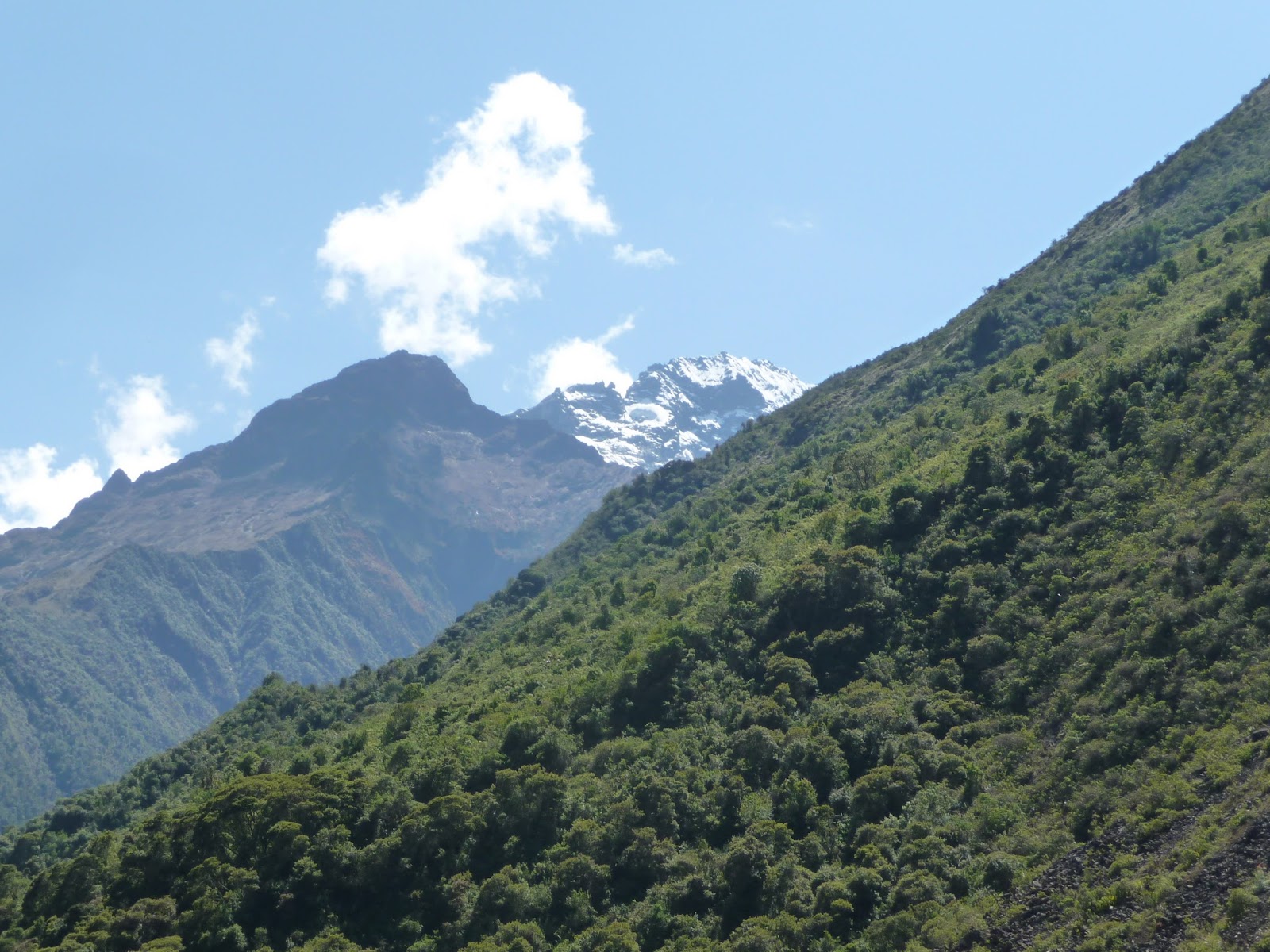
We woke up the next morning to bright sunshine. We paid £5 to the campsite owners after an interesting conversation in Spanish and headed off.  Today we were walking 19km downhill, from 3400 metres to 2800 metres above sea level. The path took us through pretty villages, over suspension & rickety wooden bridges, past snow capped mountains and along pretty riverside paths. The sun shone all the way and we really appreciated the locals who were selling water. We reached our final village (La Playa) mid afternoon and planned to set up camp. As we were walking through the main town a collectivo (minibus) pulled up and offered to take us to Saint Theresa.  We had planned to get the bus there the next morning, but he offered us a good deal and promised to take us to a campsite. 


 This turned out to be a great choice because there were hot springs (naturally heated swimming pools) in Saint Theresa and the campsite sold ice cold beer (much to Mr Greenhead's delight).  We spent a couple of hours in the pools soaking our tired muscles and enjoying the feeling of having completed the 60 km Salkantey Trek.  We definitely slept well in our sleeping bags that night.
Another early start the next morning, but this time we were catching a train to Aguas Calientes.  We shared a taxi to the hydroelectrica station and enjoyed a scenic ride through the mountains. Aguas Calientes is a small town than only be reached by train and is the starting point for a trip to Machu Picchu.
 Machu Picchu is the lost Inca city that was built in the 15 century (1400s) and was one of the few Inca cities that the invading Spanish missed when they arrived to conquer South America. Nobody knew about the city until an American historian called Hiram Bingham came across the thickly overgrown ruins in 1911 while being guided by local boy.  The city is built into the hillside, several kilometres above Aguas Calientes.  So early the next morning (5am) we caught a bus to the entry of Machu Picchu and found an English  speaking guide to give us a tour.
 As we entered the ruins, the place was shrouded in cloud and we only got glimpses of the size.  Our guide explained the history of the ruins and the Incas beliefs as we wandered between hill terraces, temples, houses and the main square. Slowly the mist and cloud lifted to reveal an amazing place, which was built to fit perfectly into the hillside. We took lots of photos as we wandered round, then headed up the mountain that over looked Machu Picchu to get an even better view. 

Wayna Picchu is a few hundred metres higher than the Inca city and is reached by  climbing up steps which Inca people put there a few hundred years ago.  They only allow 400 people up the mountain each day, so we had to book a spot and pay extra. The climb took half an hour and was worth it for the impressive view of Machu Picchu. On the way  back down we visited more ruins called Temple of the Moon and Grande Caverna. Then we spent the afternoon relaxing and soaking up the special atmosphere of the ruins.  Sadly the rain clouds started gather, so we caught the bus back and headed for the market to buy a Machu Picchu t-shirt. What a great place and a great day.
The next morning we caught another scenic train to the town of Ollantaytambo and a taxi back to Cusco. We had to change taxis half way because our driver was caught speeding by the police! Then we were back in Cusco for a couple of days seeing the sights. The Cusco cathedral is an impressive sight full of paintings, ornaments and statues. One painting is of the last supper, with a guinea pig being served to Jesus and the disciples. 

Thursday, 1 December 2011

Ecuador- The Beach (9th to 16th October)

We returned to Quito for one last time. Our bus from the jungle got in very early, but the kind lady at the hostal let us into our room. I think she felt sorry for us sat outside waiting in the dark at 5am, reading our books by torchlight. We needed to finish them, so we could change them at the English Bookstore. The owner of this shop has a brother who lives in Silver End and he knows Braintree really well, so we had a long chat about Essex. 

Once we were stocked up on books and clean clothes, we headed for the bus station again and caught a night bus to Atacambes. This town is on the north-west coast of Ecuador and is well known for being a lively beach resort. However we were looking for peace and quiet, so we caught a bus straight to Playa Esconida (Hideaway Beach).  Our limited Spanish let us down here and we took a very long time to go a very short distance, however some kind locals didn't give up on us and made sure we got to the beach. 

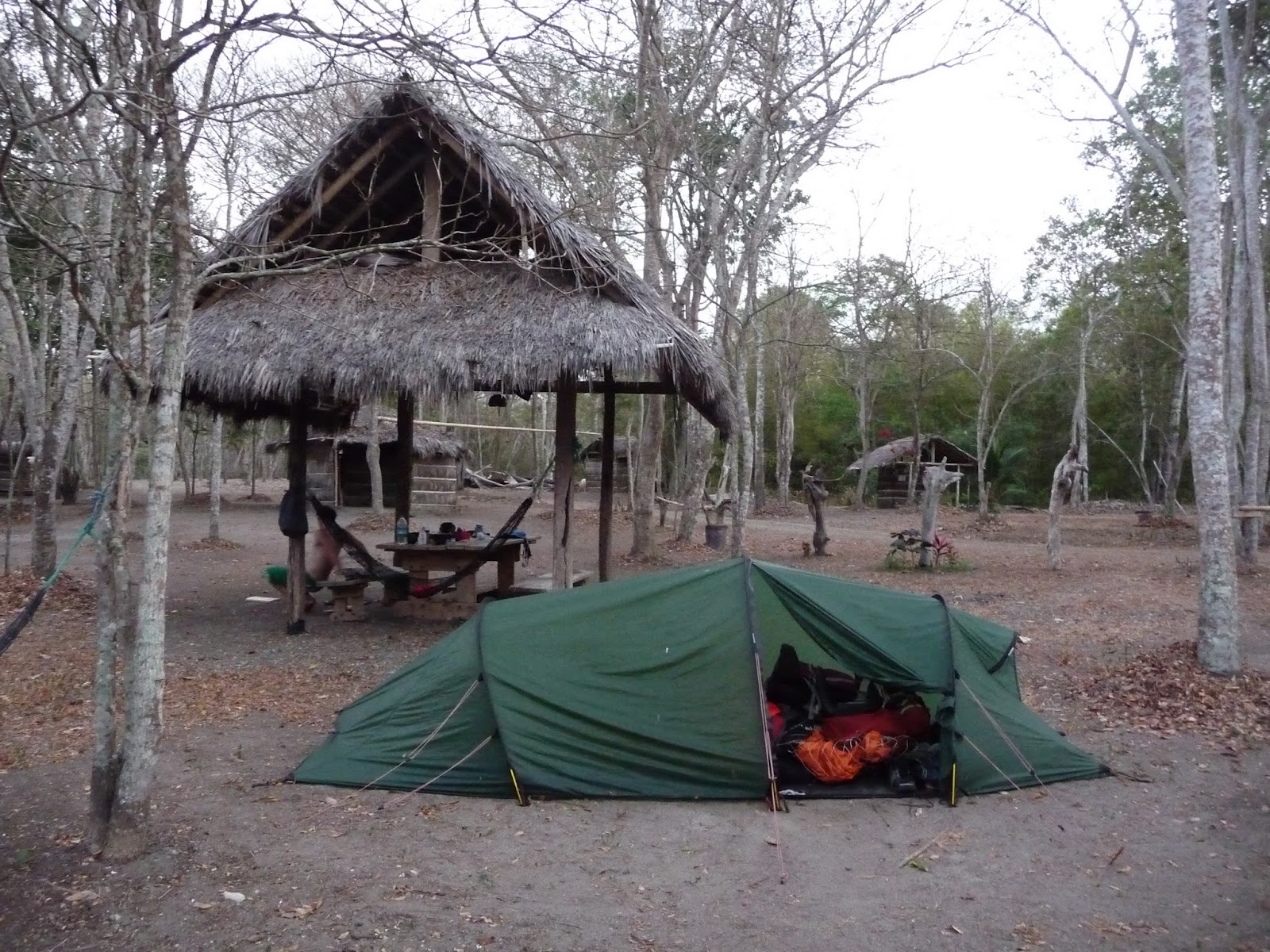
The place is run by a Canadian lady who bought the land 20 years ago and she has built an environmentally friendly resort with huts and a campsite.  We decided to go for the camping option which was beautiful apart from the sandflies. They thought we were very tasty and bit any skin not covered or sprayed with insect repellent! The restaurant food was delicious and caught fresh from the sea, but to help us save some money we decided to use the wood provided and cook our breakfast and lunch on an open fire. Mr Greenhead loves making fires, so he was in his element.  
 

We spent a week here camping and relaxing. There were caves to explore, hammocks to lie reading in, the sea to swim in, board games to play and the local towns (Tonchigue and Sua)  to walk to along the beach. The best part about the beach was when the tide was in it felt like you were on a desert island, cut off from the rest of the world. We met a mountain climber from Chile whilst we were here, who was practising one of his hobbies - slacklining. It is a bit like walking on a tightrope, but we were only 1 metre from the ground - hardwork but lots of fun. By the end of the week outdoors, we felt refreshed and ready for the long journey from Northern Ecuador to Southern Peru (several thousand miles).

Our journey started with us sitting on top of a cattle truck,  that was being driven very fast. The buses then got increasingly more luxurious as we travelled from Tonchigue to Esmeraldas to Guayaquil to Lima to Cusco. The journey took 4 nights in total, with 3 spent in a bus and one in the Flying Dog Hostal, Lima.  The best entertainment were the buskers from Tonchigue, the best bus station was Guayaquil (delicious sandwiches), the most films watched was on the bus to Lima (27 hour journey) and the comfiest seats were on the way to Cusco (leather, reclined 140 degrees). This journey involved us crossing the border back from Ecuador into Peru. They have built a brand new border crossing, but obviously run out of money and could only afford one member of staff. It took 2 hours for our bus to go through customs!


Finally we arrived in Cusco, Southern Peru. We hadn't booked a hostal but our taxi driver knew a good place near the centre of town. He was very kind, phoned ahead and got us a discount. Then when we arrived Mr Greenhead realised he had stayed here when he visited Peru 10 years ago - what are the chances of that! Cusco is at an altitude of 3400 metres above sea level, so it took me couple of days to get used to the thin air again. The jungle and beach are both at sea level, so it had been 3 weeks since we had been so high. We spent the time planning our next adventure - The Salkantay Trek and trip to Machu Picchu.

Sunday, 30 October 2011

Ecuador - The Jungle (4th to 8th October)

After a week in the mountains it was time for something completely different - the jungle. In Ecuador a trip to the jungle involves visiting the Amazon Rainforest. We left Quito on the night bus and headed for the town of Lago Agrio to meet our jungle guide.  However on the way a torrential rainstorm struck and caused a landslide that blocked the road. We were worried we would miss our trip but the local people were prepared and 6 hours later we were on our way again! We finally arrived and for the first time this trip it was hot enough to put on my shorts and flip flops.

To reach  our lodge deep in the rainforest, we had to take a bus to El Puente then a canoe trip down the Cuyabeno River.  The journey to the river took us past oil refineries and showed how important it is to protect the rainforest from oil companies who want to cut the forest down to get to the oil in the ground.  More than 25000 species of Amazonian plants contribute 20% of the oxygen in our air and 66% of all the worlds fresh water can be found here.  The canoe journey down the river showed us what a special place the rainforest is  - beautiful and untouched. We even saw our first dangerous animal - an anaconda. Our guide explained that it was only a baby at 1 metre long, apparently they can grow up to 9 metres  in length!

Two hours later we arrived at Samona Jungle Lodge, our home for the next few days.  The lodge is made up of lots of wooden huts with thatched roofs. There is a gap between the walls and roof which bugs can  get through, so you sleep under mosquito nets.  Our room was visited by cockroaches and ghekos during our stay, but nothing worse (we think!).  The tarantulas prefered to hang out in the dining area whilst we ate dinner. Apparently tarantulas only bite when they are threatened or they sense fear, at least that was what our guide told me when he convinced me to hold one. It felt really soft and feathery as it walked across my hands.

We spent our first evening back on the river in our canoe. We were searching for caymens (related to crocodiles and alligators) in the dark. To find them you have to look out for their eyes glowing in the dark, just above the surface of the water. Our guide had excellent eyesight and spotted them from a long way off.  We got to within a metre of the caymens and got some great photos, until the the boat brushed against one and the people at the front of the canoe thought they were caymen dinner! (We were at the back).

The next day started with an early morning paddle in search of monkeys.  Mr Greenhead wasn't impressed with the paddling skills of our group, but after a bit of encouragement we made our way down river.  The monkeys were incredible, chasing each other and leaping huge distances from tree to tree. We also saw a large and very colourful Toucan flying in the tree tops.  Next on the itinery was the hunt for anacondas.  We had to go on foot for this activity, so we put on our wellies, smooothered ourselves in deet (insect repellent) and set off through the squelchy mud. Most people ended up with mud and water in their wellies, but one poor girl kept falling over and ended up covered from head to toe. Unfortunately all the anacondas were hiding but we did find an electric eel and the skin shed by an 8 metre  anaconda.


On our way back for lunch we saw some more monkeys whilst we were taking a dip in the river. At this point I didn't realise piranhas lived there, though apparently you need to be bleeding alot for them to attack. The afternoon was spent relaxing on the hammocks at the lodge and finding tree frogs who seemed to like hanging round the huts. Then another evening trip down the river to watch the sunset over the laguna and spot more caymens- one of which was 6 metres long! We also saw lots of jumping fish, one of which jumped into our boat and had to be fished out admist lots of screaming.
We woke up to a torrential rain storm the next morning, which sounded amazing on the roof of our hut. You can understand how the rainforest is so green and full of life when you see the rain pour down. It carried on pouring as we headed in the canoe to a local village (Tarapuy Siona Community), but our ponchos kept us dry and finally the rain eased. We were met at the village by the pet monkey called Nacho.  He was extremely cute and was very happy to pose for photos.

We were given a tour of the village and shown how to make yam bread, which we had for lunch. We also met the villagers pet parakeet who thought Mr Greenheads fingers were rather tasty. The local shamen (witch doctor) was next on the tour. He claims to cure illnesses by chanting and waving local plants over the patient, I am not convinced it works. Then we went for a walk through thick rainforest where we saw huge conga and army ants.

Our next activity was piranha fishing. On the way to the fishing spot in the laguna, we saw lots of cute turtles diving off the logs on the banks of the river and into the water. Piranhas swim  about a metre below the surface, so you have to drop the baited line into the water and wiggle it around. Mr Greenhead was the first to catch a piranha, which it turns out is the easy part.  You aren't allowed to keep the fish,  but getting them off the line whilst their sharp teeth are snapping at your fingers is scary.  When I finally caught one I had to get Mr Greenhead to throw it back for me! Once we had run out of bait we headed back to camp for night walk in the jungle, the trees were full of huge spiders and other creepy crawlies.
Sadly our trip came to an end the next day, with a canoe trip back to the nearest road two hours away. We saw another anaconda on the way and lots of colourful birds. The full list of animals seen (though not all caught on camera) is as follows: Tamerine Monkey, Squirrel Monkey, Common Woolly Monkey, Moonsaki Monkey, Noisy Night Monkey, Anaconda, White Throated Toucan, Tree Frog, Tarantula, Black Cayman,White Cayman, Jumping (dog) Fish, Red Piranha Fish, Kingfisher, Stinky Turkey, Yellow Spotted Turtle, Amazon Forest Lizard, Tiger Heron, Green Heron,  Cockroach, Electric Eel, Sangrene, Grey Winged Trumpeteer, Conga Ant, Army Ant, Black Vulture, Woodpecker, Blue Morph Butterfly, Laughing Falcon, Parakeet, Black Caracara, Macaw, Jay, Two-toed Sloth, Grey Fishing Bat and Long Nosed Bat. Pretty impressive for a four day trip,  we would have loved to have stayed longer and explored further.

Monday, 3 October 2011

Ecudaor - 25th September to 3rd October

Wow, what a week I have had.  The volcanoes of Ecuador certainly lived up to their reputation as tough mountains!
We started with Cotapaxi, whose peak is 5897 meteres above sea level.  Our guide (Diego) picked us up from the Papa Gayo hostal and drove us to the base of the volcano.  We left the hostal in sunshine, but by the time we reached the start of our climb the wind was howling and it was sleeting!  The volcano was covered in cloud and stayed that way during the whole trip.  However our time climbing in Scotland had prepared us for bad weather and we weren´t going to let it put us off.  We put on our waterproof clothing and headed 200 metres uphill to the Rivas Refuge (4800 metres).  The refuge is a building that has a kitchen, an eating area and bunk beds for sleeping.  We spent a few hours here eating lots of carbohydrates (spaghetti bolognaise) to give us energy, spotting wildlife (foxes) and trying to get some sleep in preparation for the climb.


The climb has to start at 1am because the snow gets soft when the sun comes up and the mountain becomes more dangerous, so you need to be back down before lunch time.   After managing to get a couple of hours sleep, we got up for breakfast (a yoghurt) at midnight.  By the time we woke up the wind was even stronger and icy snow was falling.  However we had all the gear (ice axes, crampons, warm clothes) and were up for conquering the mountain.  Within 15 minutes of walking we were covered in a layer of ice, but we carried on plodding up the mountain.  Our training had helped and we were coping with the altitude very well.  In fact apart from cold hands and the wind making it a bit tricky to catch you breath, we were feeling good.

Then 2 1/2 hours into our climb disaster struck.  We had reached the deep crevasse field (deep cracks in the ice) and couldn´t find a path through.  Normally there are snow bridges, but they had collapsed after heavy snowfall and there was no way across.  Our guide tried lots of different routes but he couldn´t find a way through.  It was so frustrating because we were all keen to get to the top.  So unfortunately at a height of 5400 metres, we had to turn round and head back down - all feeling very disappointed that our hard work hadn´t led us to the top.  We headed back to the refuge for a cup of tea and tom collect our sleeping bags, then headed back to our hostal.  It rained the whole way back which made for an exciting journey because our windscreen wipers didn´t work and the first 10 miles were on pot-holed dirt roads.  Fortunately our guide had a plan, he tied shoelaces to the wipers and our friend Elias (a Swiss guy who climbed the mountain with us) had to pull them back and forwards!


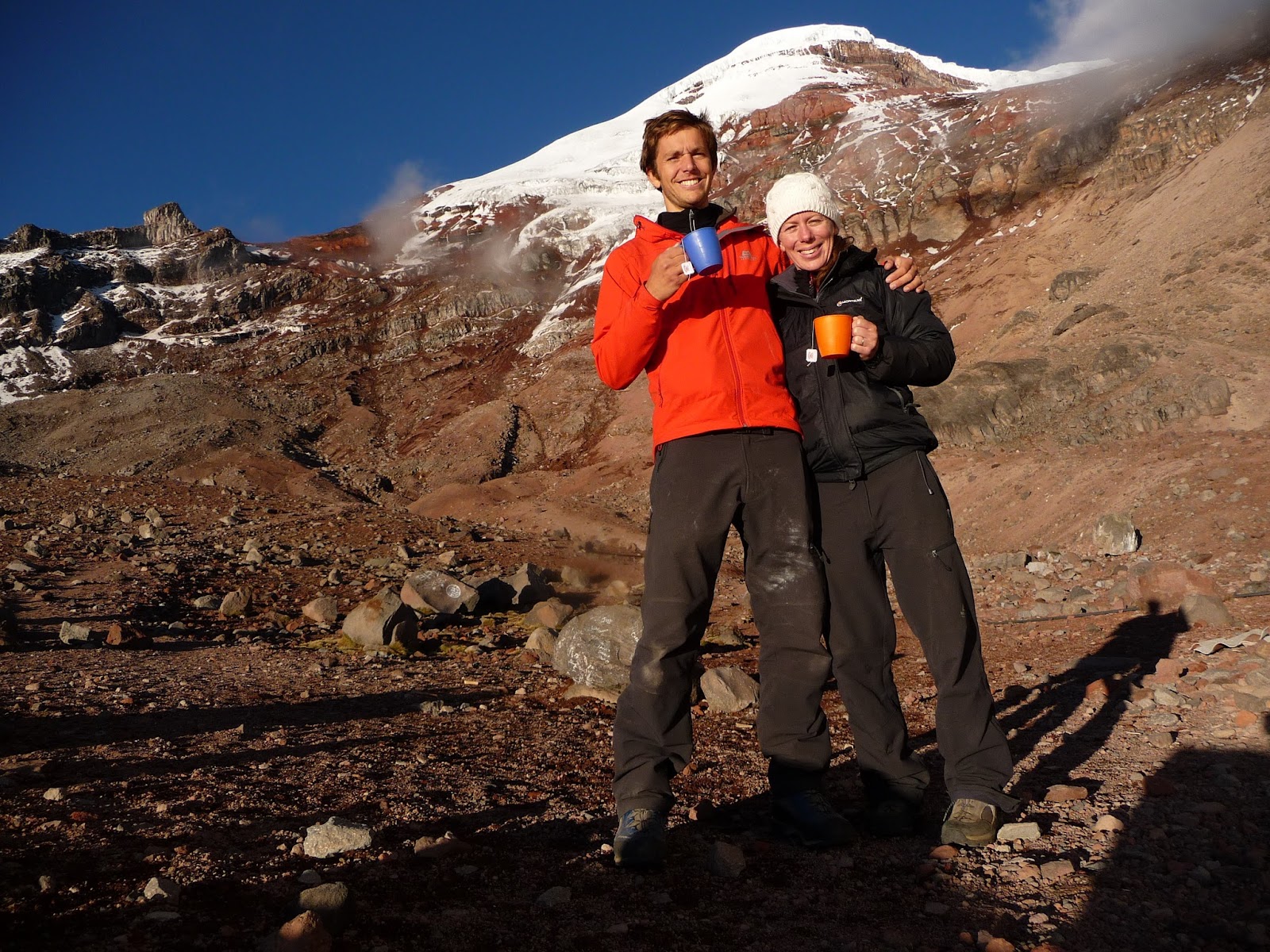
After a days rest, we tackled volcano number two - Chimborazo which is 6267 metres above sea level.   This time we left our hostal in cloud but by the evening the skies were clear blue, the wind was very gentle and we could get some great photos of the mountain at sunset.  There are two refuges on Chimborazo - we drove right up to the first one at the base of the mountain (4800m) and had some lunch (potato soup), then headed up to the second refuge for dinner and a bit of sleep.  The second refuge is called the Whymper Refuge and is 5000 metres above sea level, which had no affect on our appetite for dinner (spaghetti bolognaise again) but we did struggle to sleep.

For Chimborazo the climb starts at midnight, so we had to get up at 11pm for our breakfast.  Thankfully the weather had remained excellent and it was pretty warm for 5000m (about 0 degrees), so we started out with only a few layers on.  The first part of the climb is up a scree (loose gravel) and rock slope, then you put your crampons on for the start of the ice.  The slope was pretty steep, but we felt good and within 2 hours we were past the part most dangerous for falling rocks.  It is very icy in places, so you have to kick hard with your crampons, so that you don´t slip back down the slope.  Once you reach the rock formation called El Castillo (the castle) then you head up the ridge onto the Thielman glacier.  This is bascially a narrow snow slope and is pretty steep (60 degrees angle).  Before starting on the snow slope, we paused here for a break and checked the altitude - it was 5500metres and the highest we had ever been.  At this point we were feeling really good and keen to get to the top in a good time.
Then disaster struck again, this time in the form of altitude sickness.  I started to feel worse and worse as I got higher.  I kept on having to stop because I thought I was going to be sick.  Mr Greenhead said I turned grey in colour, even my lips! However I was determined not to stop Mr Greenhead from reaching the summit (he was still feeling great), so I kept pushing on.  But by the time we reached 5850 metres, I was stopping every 25 steps and our guide said it would take 3 or 4 more hours at such a slow pace.  He was very encouraging and wanted us to go on, but by now I was feeling sick and dizzy.  So with much regret and disappointment we turned round and headed back down.  The 6000 metre barrier still hadn´t been broken, but there will be other mountains and we had reached our highest ever altitude.  Our trip back to the hostal was under clear blue skies so we saw lots of mountains and wildlife.  We even saw Cotapaxi - the mountain that was covered in cloud when we tried to climb it.

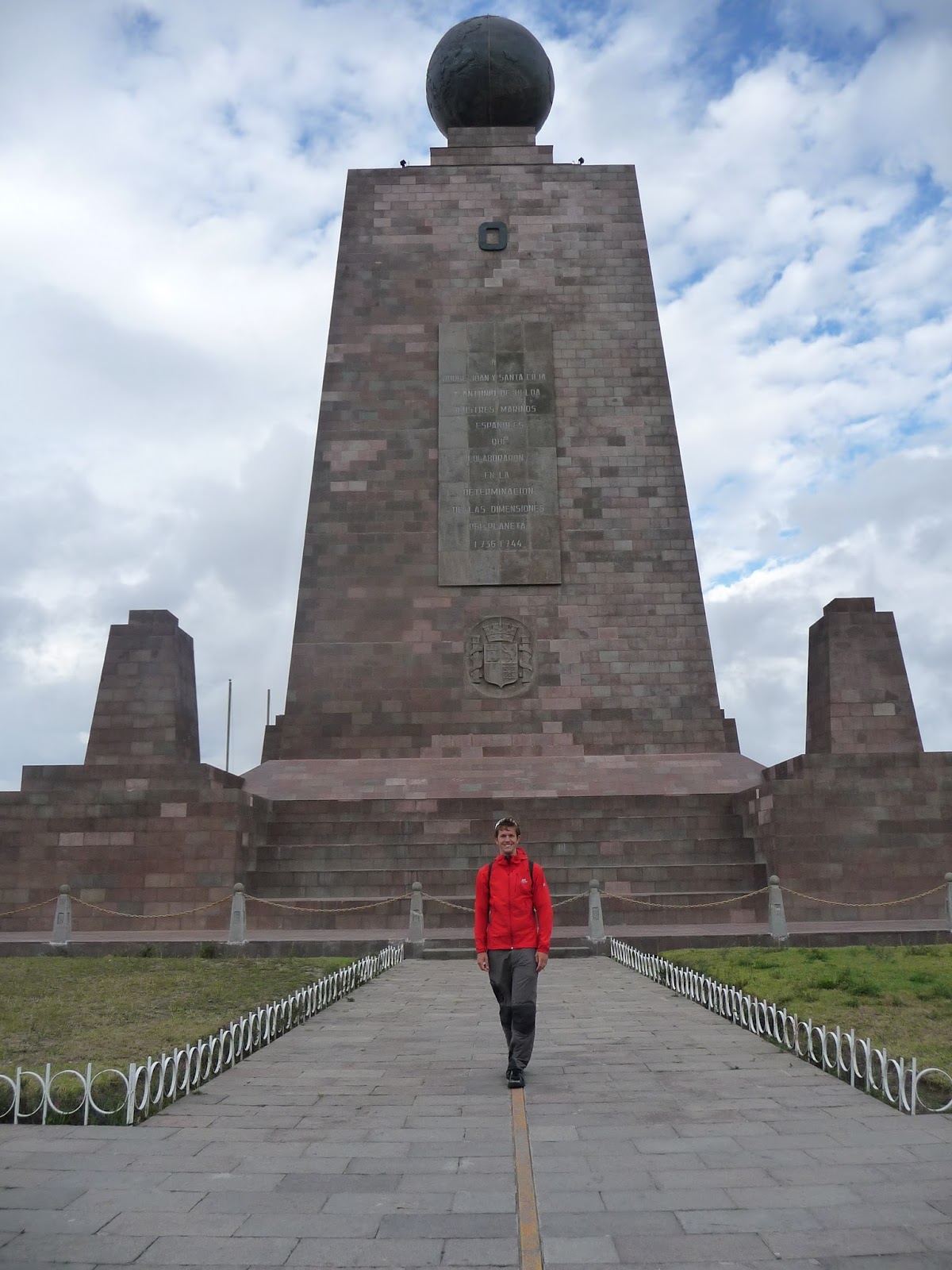
The last couple of days have been spent recovering and getting over our disappointment.  We haven´t done anything too active, but we did decide to do something very touristy and visit the middle of the world (Mitad del Mundo).  This is place where there is a monument and a line painted on the floor to mark the equator, so you can stand with a foot either side of the equator.

Our journey there was rather eventful and involved us taking 3 wrong buses.  The first wrong bus was when we attempted to go on Saturday, we ended up 1 hour south of Quito instead of 1 hour north.  So we gave up on our Saturday attempt and tried on Sunday instead.  Our second wrong bus led us in a circle which was a pain but no big problem.  However our third wrong bus almost led us to the middle of nowhere.  We tried to get off at the right place but our bus driver told us we were wrong and needed to stay on.  We presumed he was right and sat back down, however we started heading into the mountains and the journey was lasting longer than the guide book said.  Eventually we persuaded the driver that we had missed our stop and needed to get off.  He wasn´t impressed, took our return ticket and left us by a roadside toll booth (like the Dartford toll crossing but much smaller).  We later found out that we should have paid 40 cents not 2 dollars each, so who know where we were headed for that amount of money.   We waited by the toll booth for a taxi, but after 20 minutes none came, so we had to resort to sticking our thumbs out and hope that a kind local would give us a lift.  Hitchhiking is not something I have ever done before and is not a great thing to do, but we were stuck.  Thankfully a kind man with a pick up truck stopped and let us jump in the back.  He was a very fast driver and gave us an exciting ride back to the monument for free (we offered money but he said no thanks).

The monument and equator line are in a walled park which is full of shops, restaurants and people.  We had a quick trip to the top of the 30 metre monument and then got our passports stamped (we think this is legally allowed) before heading back out of the park to the real equator line.  It turns out that when the French did their measurements in 1743, they were a few hundred metres out.  When GPS was invented and used to measure the equator, they found it was actually 300 metres further north.  At the real equator line there is a museum where we had a great tour about the history of Ecuador and watched some experiments to prove it is the real equator.  The highlight of the history tour was the rainforest section where we saw giant spiders (dead), huge snake skins and shrunken human heads that had been created by rainforest warriors.  However the experiments section was even more fascinating and showed how forces change on the equator.  We watched water spin down the plug hole clockwise (south of equator), anti-clockwise (north of the equator) and straight (on the equator), we balanced an egg on a nail head and we tried to walk in a straight line (very hard).  Myself and Mr Greenhead both balanced the egg, so we got a certificate!  After an eventful day, our journey home was much more straight forward and we managed to get all the right buses for a fraction of the price.

Now we are waiting to take a night bus to Lago Agrio for a trip to the jungle, then we will be heading to the beach for some surfing.  I will hopefully be reporting again on our adventures in a couple of weeks.